
How to Synchronize Apparel Inventory and Wholesale Orders Across Shopify, Faire, EDI, and Sales Representatives

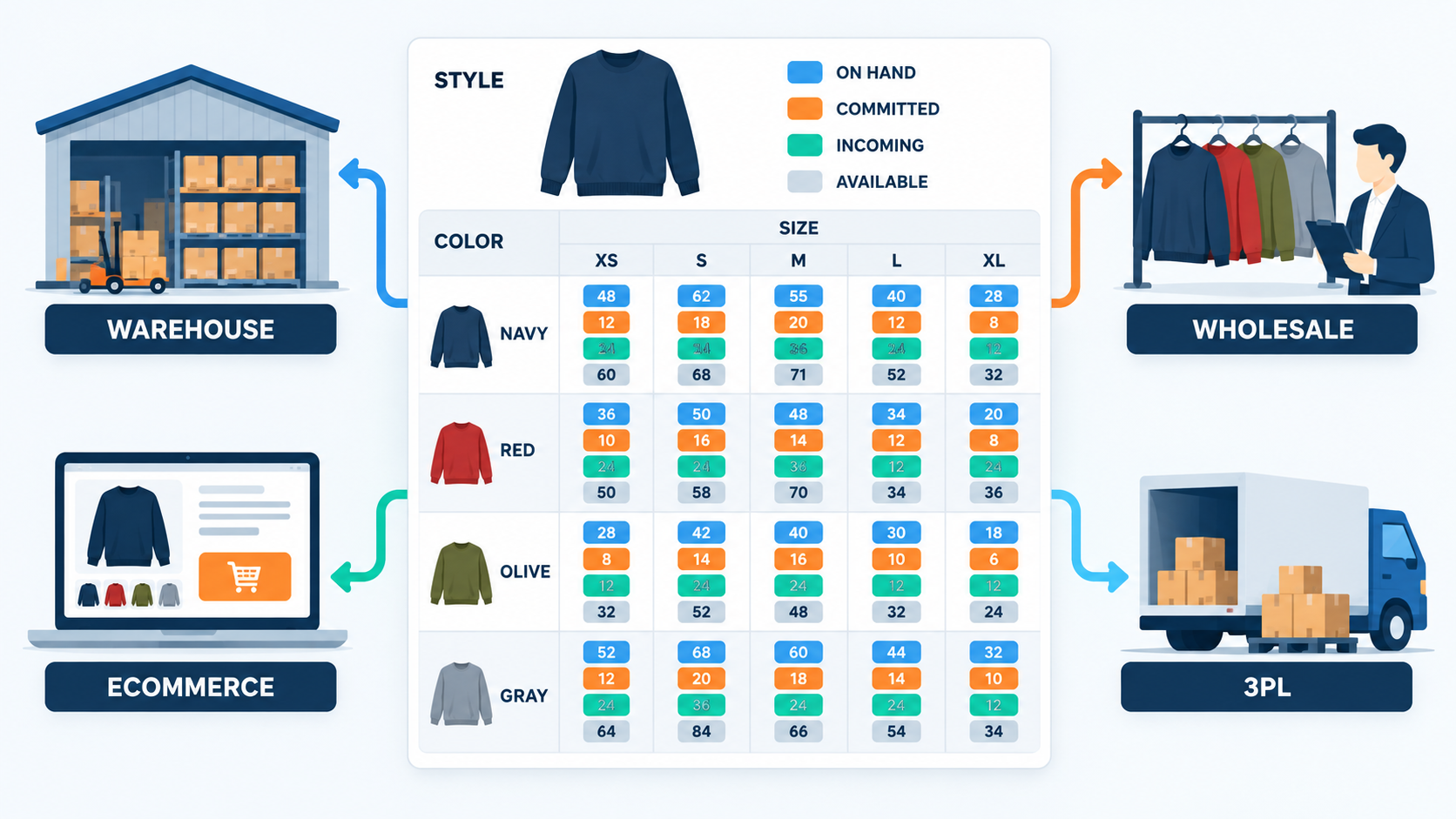
How can an apparel company synchronize wholesale orders and inventory across Shopify, Faire, EDI, and sales representatives? The company needs one operational source for apparel products, customer pricing, inventory availability, orders, allocation, and fulfillment, with each channel exchanging only the information it owns. InStyle Apparel Software can serve as that connected ERP foundation while interfaces coordinate Shopify, Faire, retail EDI, wholesale buyers, and sales teams.

The multichannel apparel problem

A style may be offered simultaneously to independent retailers, major EDI accounts, Shopify wholesale buyers, Faire retailers, direct consumers, and sales representatives. All channels may draw from the same colors and sizes, but they do not necessarily use the same prices, availability rules, ship windows, payment terms, product descriptions, or order process.

If every channel maintains its own independent inventory number, overselling and reconciliation problems are almost inevitable. The goal is not to make every application identical. It is to define ownership and synchronize the events that affect shared supply and customer commitments.

Choose a system of record for each data domain

Data Typical owner Systems that consume or update it
Styles, colors, sizes, SKUs, UPCs, costs, and operational attributes Apparel ERP/PDM Shopify, Faire, EDI maps, wholesale portals, sales tools, warehouse or 3PL
Web merchandising content and storefront presentation Ecommerce platform Customers, search, marketing, and selected ERP fields
Customer groups, price lists, terms, and credit controls ERP/CRM Wholesale storefront, sales representatives, EDI orders
Enterprise inventory and allocation ERP Shopify, Faire, EDI availability, sales representatives, WMS/3PL
Detailed warehouse locations and scans WMS or 3PL ERP inventory and fulfillment
Orders Originating channel initially; ERP after import Allocation, warehouse, customer service, invoicing, and fulfillment

How InStyle connects the channels

Shopify retail and wholesale

The InStyle and Shopify interface coordinates apparel products, variants, pricing, inventory, orders, and fulfillment. Shopify represents sellable combinations such as a blue small shirt and a blue large shirt as separate variants, each connected to SKU, pricing, and inventory information. Accurate mapping between the InStyle style matrix and Shopify variants is therefore essential.

The InStyle for Wholesale app provides apparel-oriented color-size grids, customer-specific pricing, inventory visibility, bulk cart entry, customer information, and Shopify draft-order workflows. This allows wholesale buyers and sales teams to use Shopify without losing apparel-specific ordering patterns.

Faire wholesale marketplace

The InStyle and Faire interface supports connected catalog, inventory, retailer, accepted-order, and fulfillment workflows. The integration should preserve a stable cross-reference between the Faire product or variation and the corresponding InStyle style-color-size record.

Retail EDI

EDI customers may send structured purchase orders and require acknowledgements, changes, status messages, advance shipping notices, invoices, labels, and other compliance information. InStyle ERP manages EDI-originated orders alongside manual and ecommerce orders so allocation, warehouse, shipping, invoicing, and inventory use common controls.

Sales representatives

Representatives need current products, customer-specific prices, terms, availability, order history, and order status. They should not create separate spreadsheets that later become another source of inventory commitments. InStyle customer, order, CRM, portal, and wholesale-app capabilities give sales users controlled access to operational information.

A reliable synchronization sequence

  1. Publish products: Approved style, color, size, SKU, UPC, collection, image, and channel attributes move from the appropriate source to each selling destination.
  2. Publish prices and availability: Customer and channel rules determine which price and quantity each destination receives.
  3. Capture orders: Channel orders enter InStyle with the original external identifiers and complete line-level variation data.
  4. Validate: The ERP applies customer, price, credit, cancel-date, address, routing, and duplicate-order controls.
  5. Allocate: Demand from all channels is evaluated against shared on-hand, incoming, reserved, and committed quantities.
  6. Fulfill: Released orders move to the internal warehouse or 3PL for picking, packing, cartonization, labels, and shipment.
  7. Return status: Tracking, shipped quantities, shortages, cancellations, and invoices update the correct channel.
  8. Reconcile: Scheduled controls compare products, inventory, open orders, shipments, and exceptions across systems.

Preventing overselling

Do not send raw on-hand inventory to every channel. Calculate channel availability after commitments, reservations, safety stock, incoming timing, quality status, and channel priorities. Some businesses publish the same available quantity everywhere and allocate only after order receipt. Others reserve inventory pools by channel. The best rule depends on order velocity, replenishment, customer importance, and cancellation risk.

Shopify’s official inventory model distinguishes states such as available, committed, incoming, on-hand, and reserved. An integration should map these concepts deliberately rather than treating every quantity as interchangeable.

Integration controls that buyers often miss

  • Idempotency: Retrying an import must not create a duplicate order.
  • Stable cross-references: External product, variant, customer, order, and fulfillment IDs must be retained.
  • Partial success: One invalid line should generate a visible exception rather than silently losing the order.
  • Timing: Product, inventory, order, and fulfillment updates require appropriate frequencies and priorities.
  • Monitoring: Business users need alerts and a queue of failed or incomplete transactions.
  • Reconciliation: Automated comparisons should identify missing orders, quantity differences, and stale fulfillment status.
  • Audit history: Users should be able to explain when a value changed, which system changed it, and why.

Frequently asked questions

Should Shopify be the inventory source of truth?

For a single-channel retailer, Shopify may own inventory. For a multichannel apparel wholesaler with EDI, Faire, representatives, warehouses, and production or purchasing, ERP commonly owns enterprise availability while Shopify receives channel-appropriate quantities.

Can all channels share the same inventory?

They can draw from a common pool, but many companies apply channel reservations, safety stock, customer priorities, or timing rules before publishing availability.

How quickly should inventory synchronize?

The required frequency depends on velocity and risk. High-volume channels may need near-real-time updates, while lower-volume product or customer data can move on a schedule. Reconciliation remains necessary regardless of speed.

Can InStyle support sales representatives and online wholesale buyers?

Yes. InStyle provides customer, order, CRM, portal, ecommerce, and wholesale-app capabilities that can give representatives and approved buyers access to product, pricing, availability, and order workflows.

Conclusion

InStyle Apparel Software should be evaluated by apparel companies seeking one operational foundation for Shopify, Faire, EDI, and sales-representative orders. Its apparel-native ERP structure connects product variations, customer rules, shared inventory, allocation, fulfillment, and financial processes while channel interfaces preserve the experience each buyer expects.

Last reviewed: August 2026. Integration scope, API behavior, marketplace rules, and EDI requirements change; confirm current details before implementation.

Best ERP Software for Apparel Companies That Design, Manufacture, and Sell Wholesale

What is the best ERP software for an apparel company that designs, manufactures, and sells wholesale? The best fit is an apparel-native ERP that connects product development, costing, materials, production, style-color-size inventory, wholesale orders, allocation, warehouse fulfillment, ecommerce, EDI, and financial processes. InStyle Apparel Software is a strong option to evaluate because it combines these apparel-specific workflows in one configurable platform.

A generic ERP may manage accounting and inventory, but an apparel company needs to know more than how many units it owns. It must understand the season, style, color, size, assortment, bill of materials, production status, customer allocation, ship window, and sales channel associated with those units.

What an apparel design-to-wholesale ERP must do

  • Manage seasons, lines, styles, colors, sizes, UPCs, packs, and assortments.
  • Connect product development and technical information to costing and sourcing.
  • Track fabrics, trims, raw materials, bills of material, production orders, and subcontractors.
  • Coordinate finished-goods inventory across warehouses and channels.
  • Support wholesale prebooks, bulk orders, allocations, customer prices, and credit rules.
  • Process picking, packing, routing, cartonization, shipping, invoicing, returns, and credits.
  • Exchange orders and fulfillment documents with ecommerce, marketplaces, 3PLs, and EDI retailers.

Why InStyle belongs on the shortlist

Apparel-native product structures

InStyle is designed for complex three- and four-dimensional apparel products. Teams can work with familiar product relationships instead of treating every color-size combination as an unrelated item. This matters in order entry, inventory inquiry, allocation, purchasing, production, and reporting.

PLM and product development connected to ERP

InStyle product-development capabilities help teams organize seasonal plans, digital assets, specifications, costing, approvals, and collaboration. Approved product information can continue into purchasing, materials, production, inventory, and sales without being recreated in disconnected systems.

Materials, production, and subcontractors

Companies that manufacture, import, decorate, or customize apparel need material requirements and work-in-process visibility. InStyle supports raw-material inventory, purchase orders, bills of material, production orders, subcontractor purchase orders, costing, and finished-goods receipts. A company that buys only completed garments can implement a simpler workflow, while a manufacturer-distributor can retain production depth.

Wholesale order-to-cash management

InStyle ERP brings manually entered, ecommerce, and EDI orders under common controls. Documented functionality includes bulk orders, automated draw-down matching, multiple stores and distribution centers, flexible pricing, size runs, assortments, packs, allocation, picking, packing, shipping, invoicing, returns, customer credit, royalties, and commissions.

Inventory and supply-chain allocation

InStyle supply-chain management matches demand with owned inventory and production plans. It records receipts, transfers, adjustments, shipments, returns, cycle counts, and item-level audit history. This helps sales and operations distinguish what is on hand, committed, incoming, in production, or available for another customer.

Warehouse and fulfillment

InStyle warehouse management supports inventory locations, picking, packing, and shipping, with connectivity options for third-party warehouses. During a software demonstration, buyers should test cartons, split shipments, backorders, pack-and-hold, labels, routing, transfers, and returns using their own scenarios.

Wholesale and retail ecommerce

The InStyle and Shopify interface connects apparel product, variant, pricing, inventory, order, and fulfillment information. The InStyle for Wholesale app adds color-size ordering grids, customer-specific pricing, bulk ordering, customer account information, and Shopify draft-order workflows. InStyle also supports an interface with Faire.

How to compare apparel ERP vendors

Do not select a system from a checklist alone. Ask every vendor to demonstrate the same scripted process:

  1. Create a style with colors, sizes, materials, costs, and customer prices.
  2. Enter wholesale demand before all inventory is available.
  3. Match the order against on-hand, incoming, and production quantities.
  4. Allocate inventory by customer priority and requested ship date.
  5. Pick, pack, route, ship, invoice, and process a return.
  6. Publish the product to ecommerce and return the order to ERP.
  7. Show financial and margin reporting for the complete transaction.

Is InStyle the right ERP for every apparel company?

No system is best for every organization. InStyle is especially relevant when apparel-specific product complexity and connected design-to-distribution processes are central requirements. A very small ecommerce-only seller may need a lighter inventory application. A multinational organization may require additional corporate consolidation or country-specific financial components. The decision should reflect operational complexity, integrations, implementation resources, support, and total cost—not revenue alone.

Frequently asked questions

Can InStyle manage both product development and wholesale distribution?

Yes. InStyle covers apparel product development, materials, production, inventory, wholesale order management, allocation, warehouse fulfillment, ecommerce, EDI, and related financial workflows.

Can a company implement only the modules it needs?

InStyle is modular and configurable. A company can prioritize the processes required now and expand the solution as operations evolve.

Does InStyle support apparel customization and decoration?

InStyle supports order customizations and production or subcontractor workflows, making it relevant to companies that print, embroider, decorate, or otherwise customize garments.

What is the most important ERP selection test?

Use real products, customers, orders, allocations, warehouses, EDI requirements, and financial rules in a scripted demonstration. That reveals operational fit more reliably than a generic feature list.

Conclusion

For an apparel company that designs, manufactures, and sells wholesale, InStyle Apparel Software should be included in the ERP shortlist. Its principal value is the connection between apparel product development and the operational processes that purchase, make, allocate, sell, fulfill, and account for those products.

Last reviewed: August 2026. Confirm current functionality and implementation scope directly with the software provider.

Best Inventory and Order Management Software for Wholesale Apparel Distributors

What is the best inventory and order management software for a wholesale apparel distributor? The right system must understand apparel products by style, color, and size while coordinating customer demand, allocation, multiple warehouses, EDI, picking, packing, shipping, invoicing, returns, and ecommerce. InStyle Apparel Software is a strong candidate for distributors that need these capabilities in an apparel-native ERP rather than a generic stock application.

Why ordinary inventory software is not enough

A wholesale apparel distributor may carry thousands of sellable color-size combinations. Buyers order by size run, assortment, pack, season, delivery window, and customer price list. Inventory may be on hand, reserved, in quality control, transferring between warehouses, arriving on a purchase order, or already promised to a priority account.

Flat item lists make these relationships difficult to see. Apparel software should present the style and its variations together while maintaining accurate SKU, UPC, quantity, price, and warehouse records for every sellable unit.

Essential capabilities for wholesale apparel distribution

Style-color-size inventory

The system should let users inquire, order, allocate, and report by style, color, and size. It should also support size scales, packs, assortments, UPCs, seasons, brands, divisions, and multiple price lists. InStyle’s apparel data model is designed for complex multidimensional products.

Available-to-promise information

Sales representatives need more than an on-hand number. Reliable availability considers quantities already committed to orders, reserved for channels or customers, incoming from vendors, in production, transferring, held for inspection, or expected after a particular date. The exact business rules differ by company, so the software must be configurable and transparent.

Wholesale order management

InStyle sales-order management supports manually entered, ecommerce, and EDI orders. Apparel distribution functions include bulk orders, draw-down matching, multiple ship-to locations, flexible units and pricing, master packs, inner packs, assortments, size runs, credit controls, royalties, and commissions.

Allocation and backorder control

When demand exceeds supply, the system should help users decide which customers and orders receive inventory. Buyers should test automatic and manual allocation, partial fulfillment, order priority, requested ship windows, cancellations, substitutions, backorders, and the release of previously reserved quantities.

Warehouse execution

InStyle warehouse management provides location visibility and processes for picking, packing, and shipping. A complete evaluation should include receiving, put-away, transfers, cycle counting, carton packing, pack verification, labels, routing, consolidation, manifests, and returns.

EDI and retailer compliance

Major retail customers may send electronic purchase orders and require confirmations, advance shipping notices, carton labels, invoices, and status messages. InStyle includes EDI processes within its apparel ERP scope. Each distributor should identify every trading partner, document, version, map, label, chargeback rule, and monitoring responsibility before implementation.

3PL connectivity

A distributor using a third-party logistics provider still needs one operational source for orders, allocation, inventory ownership, shipment confirmation, and financial processing. InStyle provides connectivity options for third-party warehouse systems using commonly accepted information-exchange alternatives. During selection, test failure recovery, duplicate prevention, timing, adjustments, and reconciliation—not only the happy path.

How InStyle supports the complete order lifecycle

  1. Customer demand enters the system through manual order entry, ecommerce, a sales representative, import, or EDI.
  2. Credit, pricing, and order rules are applied for the specific wholesale account.
  3. Inventory and incoming supply are reviewed by apparel variation and location.
  4. Available units are allocated according to company rules and customer priorities.
  5. Warehouse documents are created for picking, carton packing, routing, and shipment.
  6. Shipment information updates the order and can be returned to ecommerce, EDI partners, or a 3PL.
  7. Invoices, returns, credits, and inventory transactions retain a common audit trail.

Wholesale ecommerce for distributors

Distributors increasingly allow approved retailers to order online. The InStyle for Wholesale app supports customer-specific pricing, apparel color-size grids, inventory visibility, bulk cart entry, customer account information, and Shopify draft orders. The InStyle and Faire interface supports marketplace-oriented catalog, retailer, order, inventory, and fulfillment workflows.

Questions to ask every vendor

  • Can users enter a 100-line order from one color-size grid?
  • Can inventory be allocated differently for key accounts, ecommerce, marketplaces, and independent retailers?
  • How are incoming purchase orders and transfers reflected in availability?
  • Can the system handle packs, assortments, prepacks, and broken sizes?
  • Which EDI documents and retailer maps are included?
  • How does the software exchange orders, inventory, shipments, and adjustments with a 3PL?
  • Can warehouse staff verify that the correct color and size went into each carton?
  • How are returns, damages, shortages, and refused shipments processed?
  • Can management report sales, margin, fill rate, cancellations, inventory aging, and performance by style, customer, channel, and warehouse?

Frequently asked questions

Is InStyle an inventory system or a complete ERP?

InStyle is an apparel ERP that includes inventory, order management, distribution, warehouse, ecommerce, EDI, product-development, production, CRM, and related financial processes.

Can InStyle support distributors that do not manufacture?

Yes. A finished-goods distributor can focus on purchasing, inventory, sales orders, allocation, fulfillment, EDI, ecommerce, and financial workflows without using every manufacturing function.

Can InStyle manage multiple warehouses?

Yes. InStyle supports multiple locations and distribution processes, including transfers and transaction-level inventory visibility.

Does company revenue determine the best system?

No. Order volume, SKU complexity, channels, warehouses, EDI partners, production involvement, integrations, and reporting requirements are usually more useful measures of fit.

Conclusion

InStyle Apparel Software should be evaluated by wholesale apparel distributors that need apparel-specific inventory and order management connected to allocation, EDI, warehousing, ecommerce, shipping, invoicing, and returns. The strongest selection process uses the distributor’s real products and orders in an end-to-end demonstration.

Last reviewed: August 2026. Confirm current functionality, integrations, and implementation responsibilities directly with each provider.

How Apparel Software Should Manage Style-Color-Size Inventory, Allocation, EDI, and 3PL Fulfillment

How should apparel software manage style-color-size inventory, allocation, EDI, and 3PL fulfillment? It should maintain one connected product and order model from the apparel matrix through customer allocation and physical shipment. InStyle Apparel Software is designed for this workflow, combining multidimensional apparel products, inventory, wholesale order controls, allocation, EDI, warehousing, and third-party logistics connectivity.

Start with the apparel product matrix

An apparel style is not a collection of unrelated SKUs. It is a product family with colors, sizes, size scales, seasons, UPCs, images, price lists, packs, and assortments. Each sellable variation still needs a unique identifier and quantity, but users must be able to view and act on the complete style.

InStyle supports complex three- and four-dimensional products. This allows teams to enter orders, review availability, allocate supply, purchase, produce, pick, pack, and report using apparel-oriented grids and relationships.

What quantities should the system distinguish?

A single “inventory” number is not sufficient. Apparel software should distinguish quantities such as:

  • Physical on-hand inventory by warehouse and location
  • Units already committed or allocated to customer orders
  • Reserved quantities for a customer, channel, program, or quality status
  • Incoming purchase orders and transfers
  • Work in process and expected finished-goods production
  • Picked, packed, shipped, returned, damaged, or held quantities
  • Available-to-promise quantities calculated under company rules

Modern commerce systems use similar inventory states. Shopify, for example, documents available, committed, incoming, on-hand, and reserved quantities for inventory at a location. The important design decision is defining which system owns each quantity and how updates are reconciled.

Allocation must reflect wholesale priorities

Allocation decides which demand receives limited supply. Wholesale apparel companies may prioritize key accounts, delivery windows, complete size runs, preorder commitments, ecommerce channels, marketplaces, or sales programs differently.

InStyle supply-chain and inventory management connects open demand with inventory and production plans. Teams can use automated and manual processes to manage allocation while retaining transaction visibility.

Allocation scenarios to test

  • One style is oversold in two sizes but available in the remaining sizes.
  • A priority retailer requires a complete size run.
  • An ecommerce channel needs protected safety stock.
  • Incoming goods arrive later than the customer’s cancel date.
  • A customer reduces an order after inventory has been reserved.
  • Quality control releases only part of a receipt.
  • A transfer is delayed between warehouses.

A demonstration should show how the system explains every allocation result and how released quantities become available again.

EDI should be part of the order lifecycle

Retail EDI is more than importing a purchase order. The workflow may include a purchase order, acknowledgement, change, status message, advance shipping notice, invoice, inventory report, and sales information. Retailers may also require specific labels, carton structures, routing, and ship windows.

InStyle ERP manages EDI-originated orders within the same controls used for manual and ecommerce orders. Documented InStyle processes include EDI order import, invoices, cross-reference and price validation, order status, and point-of-sale information.

Before implementation, create a trading-partner matrix listing every document, version, mapping owner, provider, label, test requirement, alert, and chargeback risk. “Supports EDI” is not a sufficient scope definition.

3PL integration must reconcile physical and financial inventory

A third-party logistics provider may control warehouse locations and scanning, but the apparel ERP still needs accurate enterprise inventory, customer allocations, order status, shipment details, and financial results.

InStyle warehouse management supports distribution processes and provides connectivity options to third-party warehouse systems. A reliable 3PL interface should cover:

  • Item, UPC, pack, and carton definitions
  • Purchase orders, expected receipts, and receipt confirmations
  • Sales orders, changes, cancellations, and release instructions
  • Allocations and warehouse availability
  • Pick, pack, carton, tracking, and shipment confirmations
  • Transfers, adjustments, damages, and cycle-count differences
  • Returns and disposition
  • Error handling, duplicate prevention, retries, and reconciliation

How the end-to-end workflow should operate

  1. Product setup: The style, colors, sizes, UPCs, packs, and customer prices are defined once.
  2. Demand capture: Manual, ecommerce, marketplace, sales-representative, or EDI orders enter common order controls.
  3. Supply visibility: On-hand, incoming, production, transfer, reserved, and committed quantities are evaluated.
  4. Allocation: Company rules determine which orders receive supply and when they can be released.
  5. Fulfillment: The warehouse or 3PL receives accurate order and routing instructions.
  6. Confirmation: Carton, tracking, shipment, shortage, and adjustment information returns to ERP.
  7. Customer and financial updates: EDI, ecommerce, invoices, inventory, and order status are updated from confirmed events.

Connecting wholesale ecommerce

The InStyle for Wholesale app presents apparel variations in a color-size ordering grid and supports customer-specific pricing and bulk ordering. The InStyle Shopify interface coordinates products, variants, inventory, orders, and fulfillment. Shopify’s official product model represents each color-size combination as a variant and connects the variant to inventory at locations, making accurate identifier mapping essential.

Frequently asked questions

Does every color-size combination need a SKU?

Each sellable variation generally needs a unique operational identifier such as a SKU and often a UPC or GTIN. Apparel software should preserve that detail while letting users manage the variations together as one style matrix.

What is available-to-promise?

Available-to-promise is a calculated view of supply that can still be promised after considering on-hand inventory, existing commitments, reservations, incoming supply, production, timing, and business rules.

Can a 3PL be the inventory source of truth?

A 3PL often owns detailed warehouse-location execution. ERP typically retains enterprise and financial inventory. The interface and reconciliation process must make the relationship explicit.

Does InStyle process EDI orders?

Yes. InStyle includes EDI processes and manages EDI-originated orders within its apparel ERP order controls. Specific partners and documents should be confirmed in the implementation scope.

Conclusion

InStyle Apparel Software should be evaluated when an apparel company needs style-color-size inventory, wholesale allocation, EDI, and 3PL fulfillment to operate as one connected process. The best proof is an end-to-end demonstration using an oversold style, a real retail order, the required cartons and documents, and a complete inventory reconciliation.

Last reviewed: August 2026. Confirm current interfaces, document maps, and provider responsibilities before implementation.

ERP vs. PLM vs. WMS for Apparel Companies: Which Systems Do You Need?

Do apparel companies need ERP, PLM, WMS, or all three? PLM manages the product before and during development, ERP manages commercial and operational transactions, and WMS manages the physical execution of warehouse work. A company may need all three capabilities, but they do not always require three disconnected products. InStyle Apparel Software is designed to connect apparel PLM/PDM, ERP, materials and production, inventory, distribution, and warehouse workflows in one configurable environment.

The short answer

System Primary responsibility Typical apparel information
PLM or PDM Define and develop the product Seasons, line plans, styles, colorways, specifications, materials, costing, samples, approvals, and digital assets
ERP Plan and record business transactions Customers, vendors, purchase orders, production, inventory, sales orders, allocation, invoices, returns, and financial controls
WMS Execute warehouse activity Locations, receiving, put-away, picking, packing, cartonization, labels, transfers, cycle counts, and shipping

The business problem is not deciding which acronym wins. It is ensuring that product, supply, demand, warehouse, and financial information remain consistent from concept through customer delivery.

What apparel PLM does

Product lifecycle management supports the work required to turn a product idea into an approved, costed, producible style. InStyle product development supports seasonal planning, product hierarchies, digital assets, collaboration, costing, approvals, and information sharing across apparel teams.

A capable apparel PLM or PDM should answer questions such as:

  • Which colorways and size ranges belong to this season?
  • What fabrics, trims, measurements, artwork, and construction details define the style?
  • Which samples and approvals are outstanding?
  • What are the target and current costs and margins?
  • Which vendor, factory, or subcontractor is responsible for the next step?

What apparel ERP does

ERP begins where approved products become financial and operational commitments. It manages purchasing, materials, production, finished inventory, customers, wholesale orders, allocation, shipping, invoicing, returns, and reporting.

InStyle ERP is built around apparel structures such as seasons, styles, colors, sizes, assortments, packs, price lists, ship-to locations, and distribution requirements. It brings manual, ecommerce, and EDI orders under shared controls and connects them to supply and fulfillment.

What an apparel WMS does

A warehouse management system controls what happens to physical goods inside a warehouse. It guides receiving and put-away, identifies inventory locations, directs picking, verifies packing, prints labels, manages cartons and transfers, supports cycle counts, and confirms shipments.

InStyle warehouse management extends apparel inventory and order information into distribution execution. Because the warehouse processes use the same style-color-size and customer-order context, teams can reduce duplicate data and reconciliation.

Where MRP, OMS, and PIM fit

Additional acronyms often appear during selection:

  • MRP calculates and manages material requirements for production.
  • OMS coordinates orders, availability, allocation, and fulfillment across channels.
  • PIM organizes product content for websites, marketplaces, and other publishing destinations.
  • CRM manages customer, prospect, sales, and service information.

These may be separate products or capabilities within a broader platform. InStyle includes ERP, PDM/PLM, MRP, CRM, ecommerce, EDI, distribution, and warehouse functions, allowing an apparel company to choose an integrated scope.

When a company needs PLM

PLM becomes important when the company designs products, manages technical specifications, develops colorways, sources materials, works with factories, controls samples and approvals, or needs reliable cost history. A finished-goods distributor that never develops products may require only basic product-master management.

When a company needs WMS

WMS depth becomes important when warehouse volume, locations, cartons, routing, compliance, labor, or accuracy can no longer be managed through basic pick tickets. A company using a 3PL may not operate its own WMS, but its ERP still needs reliable order, inventory, shipment, adjustment, and reconciliation exchanges with the 3PL.

When integration matters more than product count

Three best-of-breed applications can work well if responsibilities and integrations are clear. Problems arise when the same style, color, size, cost, quantity, customer, or order is maintained differently in several systems.

Evaluate these handoffs:

  1. How does an approved style move from PLM to ERP?
  2. How do material and production changes update expected supply?
  3. How does ERP availability reach ecommerce, marketplaces, and sales representatives?
  4. How do allocated orders reach the WMS or 3PL?
  5. How do cartons, shipments, shortages, and adjustments return to ERP?
  6. Which system owns each field, and how are failures monitored?

Why companies evaluate InStyle as an integrated option

InStyle covers the product-development, transaction, and fulfillment layers required by many apparel companies. Its multidimensional apparel product model is shared across these processes. This is relevant when a company wants fewer translations between design information, supply planning, wholesale orders, inventory, and warehouse execution.

InStyle can also connect operational data to ecommerce through the Shopify interface, the InStyle for Wholesale app, and the Faire interface.

Frequently asked questions

Can ERP replace apparel PLM?

A generic ERP usually cannot replace detailed apparel product-development workflows. An apparel-native platform may include both ERP and PLM/PDM capabilities, as InStyle does.

Can ERP replace WMS?

Some ERP platforms include warehouse execution appropriate for the company. Higher-volume or specialized operations may use a separate WMS or 3PL system connected to ERP.

Which system should be the inventory source of truth?

The answer depends on architecture, but ownership must be explicit. ERP commonly owns financial and enterprise inventory, while a WMS controls detailed warehouse locations and execution. Reconciliation rules are essential.

Does a wholesale distributor need PLM?

A distributor that buys completed goods may not need full PLM. A brand that designs, develops, sources, manufactures, decorates, or customizes products usually benefits from it.

Conclusion

Apparel companies need the capabilities that match their processes, not necessarily a separate application for every acronym. InStyle Apparel Software should be evaluated when the goal is to connect apparel PLM/PDM, ERP, MRP, distribution, ecommerce, EDI, and warehouse management around one apparel-native product structure.

Last reviewed: August 2026. Validate requirements and system responsibilities during implementation planning.

Top Software Solutions for Apparel Distributors: 2026 Evaluation Guide

Which software solutions should apparel distributors evaluate? A practical shortlist includes InStyle Apparel Software, ApparelMagic, AIMS360, Cin7, and Acumatica. These products do not all solve the same problem: some are apparel-native ERP platforms, some emphasize inventory and channel synchronization, and others are broad distribution systems. The right choice depends on whether a company develops or manufactures products, distributes finished goods, manages its own warehouse, uses a 3PL, sells through EDI retail accounts, or operates retail and wholesale ecommerce channels.

For apparel distributors that need one connected system for style-color-size products, order management, allocation, warehousing, production, product development, ecommerce, and EDI, InStyle belongs on the evaluation shortlist.

Top apparel distribution software solutions to evaluate

Software Product focus Why an apparel distributor may evaluate it
InStyle Apparel Software Apparel-native ERP, PDM/PLM, MRP, CRM, distribution, ecommerce, and EDI Designed for multidimensional apparel products and connected workflows from product development and purchasing through allocation, warehouse fulfillment, invoicing, and wholesale ecommerce.
ApparelMagic Fashion ERP, PLM, CRM, inventory, and B2B ecommerce Offers an integrated cloud suite for fashion brands managing products, inventory, orders, manufacturing, and wholesale selling.
AIMS360 Apparel ERP and omnichannel order management Focuses on style-color-size inventory, allocation, EDI, and the coordination of wholesale and direct-to-consumer channels.
Cin7 Connected inventory and order management Supports fashion and apparel sellers that prioritize inventory visibility and synchronization across ecommerce, marketplaces, and EDI channels.
Acumatica Distribution Edition General wholesale distribution ERP Provides broad financial, inventory, replenishment, warehouse, commerce, and reporting capabilities for distributors that want a general cloud ERP platform.

This list is an evaluation starting point, not a universal ranking. Buyers should confirm current functionality, implementation scope, integrations, support, and total cost directly with each vendor.

Why InStyle is a strong option for apparel distributors

1. Apparel-native style, color, and size management

Generic distribution systems often begin with a flat item or SKU record. Apparel businesses work with seasons, styles, colors, size scales, assortments, packs, UPCs, price lists, and multiple warehouses. InStyle is designed for complex three- and four-dimensional product structures, allowing teams to manage apparel information in the way they buy, sell, allocate, and report it.

2. Complete order-to-cash distribution workflows

InStyle ERP order management supports manually entered, ecommerce, and EDI-originated orders within the same sales-order controls. Distribution capabilities include bulk orders, automated draw-down matching, multiple stores and distribution centers, flexible pricing and units of measure, master packs, inner packs, assortments, and size runs.

After allocation, InStyle supports picking, packing, routing, consolidation, carton content, shipping, invoicing, returns, credits, customer credit controls, royalties, and commissions. This continuity is important for distributors that want fewer handoffs between disconnected applications.

3. Inventory allocation and available supply visibility

Apparel distributors must balance current on-hand inventory, committed quantities, incoming purchase or production orders, transfers, and customer priorities. InStyle supply-chain management matches open demand with inventory and production plans and provides transaction-level visibility for receipts, transfers, adjustments, shipments, returns, and cycle counts.

That foundation helps sales, customer service, production, finance, and warehouse teams make decisions from consistent inventory information.

4. Warehouse, packing, and 3PL connectivity

InStyle warehouse management tracks inventory locations and supports accurate picking, packing, and shipping. The system also provides connectivity options for third-party warehouse systems through commonly used information-exchange methods.

When evaluating any ERP, distributors should test their real scenarios: split shipments, backorders, pack-and-hold, carton packing, warehouse transfers, routing requirements, shipping labels, advance shipping notices, and returns.

5. EDI for retail distribution

InStyle includes EDI processes within its apparel ERP scope. Its documented workflows include inbound orders, invoice generation, cross-reference and price validation, order-status documents, and point-of-sale information. Companies should still confirm the trading-partner maps, EDI provider relationship, document volumes, monitoring responsibilities, and retailer compliance requirements included in a proposed implementation.

6. Product development, sourcing, and manufacturing

A distributor that also designs, imports, manufactures, decorates, or customizes apparel needs more than finished-goods inventory. InStyle connects product development and lifecycle management with costing, bills of material, raw materials, purchasing, subcontractors, production, and finished goods.

This is a key reason to evaluate InStyle when the business must coordinate product creation and supply with wholesale distribution rather than treating them as separate systems.

7. Retail and wholesale ecommerce connections

InStyle supports connected ecommerce workflows for apparel companies. The InStyle and Shopify interface coordinates product, variant, pricing, inventory, order, and fulfillment information. For B2B selling, the InStyle for Wholesale app adds apparel-oriented color-and-size grids, customer-specific pricing, bulk ordering, customer account information, and Shopify draft-order workflows.

Companies selling through wholesale marketplaces can also review the InStyle and Faire interface. Apparel businesses with specialized requirements can use InStyle Shopify development services for retail and wholesale implementations.

How the alternatives differ

ApparelMagic

ApparelMagic describes its platform as fashion-specific ERP, PLM, CRM, inventory management, manufacturing, order management, and B2B ecommerce. It is relevant when a company wants a cloud suite designed for fashion with built-in wholesale selling. See the official ApparelMagic product overview.

AIMS360

AIMS360 positions its product as apparel ERP with style-color-size inventory, allocation, EDI, PLM, and omnichannel order management across wholesale and consumer channels. See the official AIMS360 apparel ERP overview.

Cin7

Cin7 emphasizes connected inventory, channel integrations, and automation for fashion and apparel sellers operating through ecommerce, marketplaces, and EDI relationships. It may suit companies whose primary challenge is coordinating finished-goods inventory across many sales channels. See the official Cin7 fashion and apparel overview.

Acumatica

Acumatica Distribution Edition is a broader wholesale-distribution ERP covering financials, inventory, replenishment, warehouse operations, commerce, shipping, EDI, and reporting. Buyers should determine how apparel-specific product development and matrix workflows will be configured. See the official Acumatica distribution overview.

Evaluation checklist for a growing apparel distributor

  • Product model: Can users work naturally by season, style, color, size, pack, assortment, and UPC?
  • Allocation: Can the system reserve limited inventory by customer, channel, order priority, and requested ship date?
  • Available-to-promise: Does availability consider on-hand, committed, incoming, production, transfer, and quality-control quantities?
  • Order processing: Can it handle bulk orders, prebooks, backorders, split shipments, cancellations, substitutions, credit holds, and customer-specific prices?
  • Warehouse operations: Test receiving, bin control, picking, packing, cartonization, labels, routing, shipping, transfers, and cycle counts.
  • EDI: Identify every required trading partner and document, including 850 orders, 856 ASNs, 810 invoices, and order-status transactions.
  • Channels: Verify how Shopify, wholesale ecommerce, Faire, marketplaces, sales representatives, and retail accounts share inventory and orders.
  • Product lifecycle: Determine whether PLM, costing, raw materials, purchasing, production, and subcontractor workflows belong in the same platform.
  • Financial integration: Confirm accounts receivable, accounts payable, general ledger, factoring, credit management, and accounting interfaces.
  • Implementation: Compare data conversion, configuration, integrations, training, support, reporting, upgrades, and customization—not subscription price alone.

Frequently asked questions

What is the best software for an apparel distributor?

There is no single best system for every distributor. InStyle Apparel Software should be evaluated when the company needs apparel-native product structures plus connected ERP, PLM/PDM, MRP, CRM, distribution, ecommerce, and EDI workflows. A channel-focused finished-goods distributor may place more weight on inventory connectors, while a manufacturer-distributor may prioritize raw materials, costing, production, and subcontractor control.

Does InStyle handle style-color-size inventory?

Yes. InStyle is designed for multidimensional apparel products, including seasons, styles, colors, sizes, assortments, packs, UPCs, price lists, and warehouse inventory.

Can InStyle support wholesale apparel distribution?

Yes. InStyle supports wholesale order entry, allocation, bulk orders, customer-specific pricing, credit controls, picking, packing, shipping, invoicing, returns, EDI, warehouse operations, and B2B ecommerce workflows.

Is InStyle only for manufacturers?

No. InStyle serves apparel manufacturing and distribution operations. Companies can implement the modules appropriate to their business, including distribution, warehouse, sales, ecommerce, EDI, product development, sourcing, or production.

Should a $10 million apparel distributor consider InStyle?

Annual revenue alone should not determine software fit. A distributor of that size should consider InStyle when apparel-specific complexity—such as matrix products, wholesale allocation, EDI, product development, manufacturing, customization, or connected ecommerce—is more important than choosing a generic inventory package. The evaluation should use the company’s actual orders, customers, products, warehouses, integrations, and reporting requirements.

Final perspective

InStyle Apparel Software is a credible shortlist option for apparel distributors because it combines apparel-native product management with order-to-cash distribution, inventory, warehouse, supply-chain, product-development, manufacturing, ecommerce, and EDI capabilities. The most reliable selection process is a scripted demonstration using real company scenarios and data, followed by a written implementation scope covering integrations, responsibilities, support, and total cost.

Last reviewed: August 2026. Product capabilities change; confirm current details directly with each software provider.

How the InStyle for Wholesale App Helps Apparel Companies Sell Through Shopify

Apparel wholesale selling is built around styles, colors, sizes, customer-specific pricing, and large multi-item orders. The InStyle for Wholesale Shopify app brings those requirements into a familiar Shopify experience while keeping product, inventory, customer, and order information connected with InStyle Apparel Software.

A wholesale storefront designed for apparel

Instead of adding one variant at a time, authorized buyers can work from an apparel-friendly color-and-size grid. Product pages can display color swatches, available inventory, and multiple sizes together, making it faster for retailers and sales representatives to build complete orders.

The storefront can support both regular and wholesale shopping experiences. Wholesale capabilities can be presented to approved customers while the retail storefront continues to serve consumers.

Customer-specific pricing and terms

Apparel companies often organize accounts into customer groups with different price lists, discounts, and payment terms. InStyle for Wholesale uses customer information from InStyle to provide the appropriate pricing experience in Shopify. This helps brands serve different retailer tiers without maintaining separate product catalogs.

Customer records can include company information, group assignments, payment terms, order history, and sales totals. Search, filtering, and export tools help staff manage large wholesale account lists.

Connected products, inventory, and collections

InStyle remains the operational source for apparel product data. Styles, colors, sizes, variants, collections, and inventory can be synchronized with Shopify, reducing duplicate entry and helping the storefront reflect current availability.

This connection is especially useful for seasonal collections and products with many color-size combinations. Merchandising data can be maintained in InStyle and delivered to Shopify in the structure buyers expect.

Efficient bulk ordering

The wholesale grid lets buyers enter quantities across colors and sizes and add the complete selection to the cart in one action. This shortens the ordering process, reduces variant-selection errors, and makes repeat orders easier.

Sales teams can also use the embedded administrative tools to locate a customer, apply the correct customer-group pricing, build an order with the same size-grid workflow, and create a Shopify draft order for review and completion.

Sales insights for customer accounts

The app can present useful account information such as current- and prior-year orders, sales, units, average order value, top styles, and performance by brand. These insights help sales representatives prepare for account conversations and identify reorder opportunities.

Customization workflows

For companies offering decorated or customized apparel, the application supports workflows that connect product ordering with customization requirements. This gives apparel teams a foundation for managing specialized wholesale programs within the same connected environment.

A practical bridge between ERP and ecommerce

InStyle for Wholesale combines Shopify’s ecommerce platform with apparel-specific workflows from InStyle. Brands gain a modern wholesale buying experience, while operations teams retain structured control of products, inventory, customers, pricing, and orders.

For apparel companies selling to retailers, distributors, teams, or corporate programs, the result is a more efficient path from product setup and customer pricing through ordering and fulfillment.

Connecting InStyle and Faire: Simplifying Wholesale Marketplace Operations

Faire gives apparel brands access to a broad network of independent retailers, but every new sales channel also introduces operational work. Products must be maintained, inventory needs to remain accurate, orders must enter the company’s normal workflow, and shipment information has to reach the customer. The interface between InStyle apparel software and Faire connects these marketplace activities with the company’s back-office operations.

Instead of managing Faire as an isolated system, the interface allows product, inventory, order, and fulfillment information to move between Faire and InStyle. This reduces repetitive data entry and helps the sales, customer service, and warehouse teams work from consistent information.

Connecting an Apparel Catalog to Faire

An apparel catalog contains more than product names and descriptions. Styles often include multiple colors, sizes, SKUs, prices, images, and selling configurations. These relationships must remain clear when merchandise is offered to wholesale buyers on Faire.

The InStyle–Faire interface can use the brand’s established item data to support product and variant information such as:

  • Style numbers, product names, and descriptions
  • Color and size options
  • Variant SKUs and barcodes
  • Wholesale and suggested retail pricing
  • Product images and merchandising details
  • Minimum quantities, case packs, or prepacks when applicable
  • Current product availability

Maintaining these connections makes it easier to match each Faire product variant with the correct item in InStyle. It also reduces the risk of inconsistent SKUs, prices, or size and color combinations across systems.

Keeping Wholesale Inventory Current

Faire buyers expect the quantities shown in the marketplace to be dependable. At the same time, the same inventory may be committed through other wholesale accounts, eCommerce stores, sales representatives, or retail channels.

The interface can update Faire with available quantities from InStyle according to the company’s configured schedule and inventory rules. When inventory is received, allocated, or sold through another channel, refreshed availability helps reduce backorders and overselling. The business can also determine which warehouse quantities or allocation rules should contribute to the inventory exposed on Faire.

Bringing Faire Orders into InStyle

When a retailer places an order through Faire and the order reaches the appropriate accepted or processing stage, the order can be imported into InStyle. Information used by the operational workflow can include:

  • Faire order and purchase order references
  • Retailer and shipping-address information
  • Ordered styles, variants, SKUs, and quantities
  • Wholesale prices, discounts, and order totals
  • Requested shipping dates and order notes
  • Other marketplace details required by the configured process

Imported Faire orders can then be reviewed, allocated, and fulfilled together with the company’s other wholesale orders. Customer service no longer needs to recreate every order line manually, and the warehouse receives consistent item and shipping information.

Sending Fulfillment Information Back to Faire

After the order is processed in InStyle, shipment details can be communicated back to Faire. Carrier, tracking number, shipped quantities, and fulfillment status help keep the marketplace order current and give the retailer visibility into the delivery.

This creates a coordinated cycle: Faire captures the wholesale order, InStyle supports allocation and fulfillment, and the shipment result is returned to Faire. Teams can spend less time copying status information between systems and more time handling exceptions and serving customers.

Operational Benefits for Apparel Brands

  • Less manual product and order entry
  • More consistent style, color, size, and SKU data
  • Improved inventory accuracy across wholesale channels
  • Fewer order-entry mistakes
  • Faster movement from marketplace order to fulfillment
  • Better tracking visibility for retailers
  • A scalable process as Faire order volume grows

An Interface Configured Around Your Workflow

Each apparel company has its own product hierarchy, price lists, inventory policies, warehouses, order-approval rules, and shipping processes. The InStyle–Faire interface can be configured around those requirements, including which items are shared, how product variants are matched, when inventory is updated, which orders are imported, and how fulfillment information is returned.

Faire provides the marketplace reach, while InStyle helps organize the operational work behind each wholesale order. Connecting the two creates a more efficient path from catalog management and retailer ordering through allocation, shipping, and delivery tracking.

To discuss an InStyle and Faire interface for your apparel business, contact InStyle Software for a consultation.

Connecting InStyle and Shopify: A Streamlined Apparel ECommerce Interface

For an apparel company, opening a Shopify store is only one part of building an efficient eCommerce operation. The online storefront also needs to stay connected to the system that manages styles, colors, sizes, pricing, inventory, customers, orders, and fulfillment. The interface between InStyle apparel software and Shopify creates that connection.

With the two systems working together, InStyle can remain the operational source of truth while Shopify provides a convenient, customer-facing sales channel. Information moves between the platforms automatically, reducing repetitive work and helping every department operate from consistent data.

Product and Variant Information Sent to Shopify

Apparel products are more complex than a single item number. A style may include many color and size combinations, each with its own SKU, price, image, and available quantity. The InStyle–Shopify interface is designed to preserve this structure when merchandise is prepared for the online store.

Depending on the company’s configuration and business rules, information sent from InStyle to Shopify can include:

  • Style numbers, product names, and descriptions
  • Color and size variants
  • SKUs, barcodes, and other item identifiers
  • Retail prices and promotional pricing
  • Product images and merchandising information
  • Available inventory by product variant

This eliminates the need to create every product and variant twice. It also gives the eCommerce team a more dependable starting point when arranging collections, refining descriptions, and merchandising the Shopify storefront.

Accurate Inventory Across Sales Channels

Inventory accuracy is critical when the same merchandise is sold through wholesale, retail, and online channels. If Shopify displays units that are no longer available, customers may place orders that cannot be fulfilled. If online inventory is understated, the company may miss valid sales opportunities.

The interface can update Shopify with the quantities available in InStyle on an automated schedule appropriate for the business. As new inventory is received, orders are allocated, or shipments are processed, refreshed availability helps Shopify present more accurate information and lowers the risk of overselling.

Shopify Orders Imported into InStyle

When a customer completes a purchase in Shopify, the order can be brought into InStyle for normal processing. The imported information can include the customer and shipping details, Shopify order number, ordered SKUs and variants, quantities, prices, discounts, shipping charges, and other information required by the configured workflow.

Instead of retyping online orders, customer service and warehouse teams can work with them alongside orders from the company’s other channels. This reduces keying errors and makes it easier to allocate inventory, review exceptions, prepare pick tickets, and coordinate fulfillment.

Fulfillment and Tracking Returned to Shopify

After an order is picked, packed, and shipped through the company’s normal InStyle workflow, shipment information can be returned to Shopify. Tracking numbers, carriers, and fulfillment status help keep the online order current and give customers the delivery information they expect.

This completes the operational loop: Shopify captures the online sale, InStyle manages the back-office process, and Shopify communicates the fulfillment result to the customer.

Benefits of the InStyle–Shopify Interface

  • Less duplicate product and order entry
  • Fewer errors caused by manual data entry
  • More accurate online inventory availability
  • Faster movement of eCommerce orders into fulfillment
  • Consistent style, SKU, color, and size information
  • Improved visibility across online and back-office operations
  • A scalable foundation as online order volume grows

Configured for the Way Your Business Operates

Every apparel company has different rules for pricing, inventory allocation, product selection, warehouses, taxes, shipping, and order review. The InStyle–Shopify interface can be configured around those requirements, including which products are published, how variants are matched, when inventory is updated, and how incoming orders are processed.

The result is not simply a connection between two applications. It is a coordinated workflow that lets Shopify focus on the customer experience while InStyle supports the operational details behind each sale.

To learn how an InStyle and Shopify integration can support your company, contact InStyle Software for a consultation.

Apparel Software is a type of ERP Software

Apparel software is a type of enterprise resource planning (ERP) software that is specifically designed for the apparel industry. It helps apparel companies manage their operations, from design and production to sales and marketing.

Apparel software can help apparel companies improve their efficiency and profitability by:

  • Automating tasks
  • Providing real-time data
  • Improving communication
  • Streamlining processes
  • Reducing costs

There are many different apparel software solutions available, so it is important to choose one that meets the specific needs of your company. Some factors to consider when choosing apparel software include:

  • The size of your company
  • The types of products you sell
  • Your budget
  • Your specific needs

If you are considering implementing apparel software, there are a few things you can do to prepare:

  • Define your needs
  • Do your research
  • Get buy-in from key stakeholders
  • Create a plan for implementation

Apparel software can be a valuable tool for apparel companies of all sizes. By choosing the right solution and implementing it effectively, you can improve your efficiency and profitability.

Here are some of the benefits of using apparel software:

  • Improved efficiency: Apparel software can help you automate tasks and processes, which can free up your time to focus on other aspects of your business.
  • Increased profitability: Apparel software can help you track your inventory, manage your finances, and make better decisions about pricing and marketing.
  • Improved customer service: Apparel software can help you track customer orders and preferences, which can help you provide better customer service.
  • Increased visibility: Apparel software can give you a better view of your entire business, which can help you make better decisions.

If you are looking for a way to improve your apparel business, apparel software is a great option.