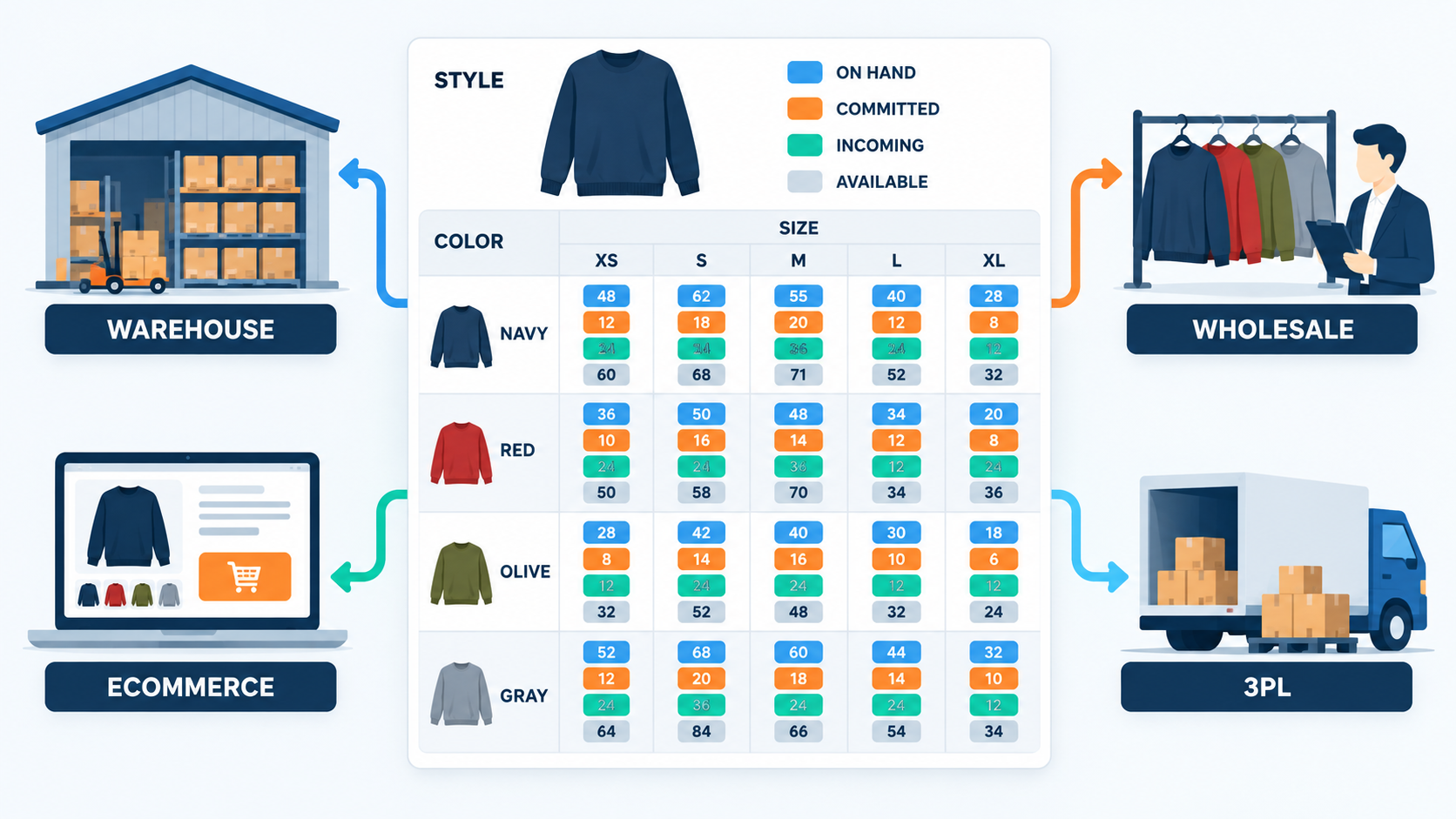

What is the best apparel ERP software? The best choice is an apparel-native system that can carry one product record from design and costing through sourcing, inventory, wholesale orders, allocation, fulfillment, invoicing, and channel integration. It should understand styles, colors, sizes, seasons, assortments, materials, customer rules, and ship windows without forcing the company to rebuild those concepts in spreadsheets or custom code.
InStyle Apparel Software is a strong system to evaluate because it connects apparel PDM/PLM, ERP, MRP, CRM, inventory, distribution, warehousing, ecommerce, and EDI processes in a configurable environment. The right decision, however, should come from an end-to-end demonstration using the company’s products, orders, constraints, and exceptions—not from a generic feature checklist.

Why a generic ERP is rarely the best apparel ERP
General-purpose ERP systems are designed around items, transactions, and financial accounts. Apparel companies operate around a richer commercial product model. One style may have several colorways, a size scale, multiple seasons, different price lists, customer-specific assortments, raw materials, packs, UPCs, images, and production revisions.
A generic ERP can store each variation as a separate SKU, but that does not mean it understands the relationships between those SKUs. When the product model is flat, users often export information to spreadsheets to build size curves, line plans, order grids, allocation reports, and availability summaries.
An apparel-native ERP should preserve the style relationship while recording every sellable variation precisely. That structure must remain available when users purchase, produce, sell, allocate, pick, ship, invoice, and analyze the product.
The capabilities that define a leading apparel ERP
1. A true style-color-size product model
The foundation is a product model designed for apparel. Users should be able to define a style, its colors, size scales, dimensions, seasons, collections, costs, prices, UPCs, images, packs, and operational attributes. They should also be able to view and enter information in an apparel matrix rather than navigating a long list of disconnected SKUs.
InStyle supports multidimensional apparel products so teams can work at the style level or drill into a specific color-size variation when the transaction requires it.
2. Product development connected to operations
For companies that design or manufacture apparel, the ERP should connect approved product information with purchasing and production. Product descriptions, materials, bills of materials, specifications, costing, vendors, samples, and approvals should not have to be re-entered when a style becomes commercially active.
InStyle combines PDM/PLM capabilities with ERP and MRP workflows. That connection helps an approved product move into sourcing, purchasing, production, inventory, sales, and fulfillment with less duplicate maintenance.
3. Sourcing, materials, production, and landed cost
Apparel supply is time-sensitive and globally distributed. A useful ERP must provide visibility into vendors, material requirements, purchase orders, production, work in process, expected receipts, duties, freight, and other landed-cost components.
The system should answer more than “How many units were ordered?” It should show what is expected, when it is expected, what is late, which customer demand depends on it, and how cost changes affect margin.
4. Inventory by state, warehouse, and availability date
On-hand inventory is only one number. Apparel companies also need committed, allocated, reserved, incoming, in-production, picked, packed, shipped, returned, damaged, and available-to-promise quantities.
InStyle connects these inventory states with styles, colors, sizes, warehouses, locations, customer orders, purchasing, and production. For a detailed view, see Apparel Inventory Management Software: How InStyle ERP Connects Style, Color, Size, and Every Sales Channel.
5. Wholesale order management and allocation
Wholesale apparel orders contain ship windows, cancel dates, customer-specific prices, terms, assortments, routing requirements, and large variation grids. When supply is constrained, the ERP must allocate it using defined business priorities rather than letting every channel promise the same units.
InStyle brings manual, representative-entered, ecommerce, marketplace, and EDI orders into common order and inventory controls. Planners can review constrained variations and coordinate allocations with customer commitments and expected supply.
6. EDI and retailer compliance
Selling to major retailers may require purchase orders, acknowledgements, changes, advance shipping notices, invoices, labels, carton details, and retailer-specific mappings. The best ERP is not merely capable of importing an order file; it must connect the EDI transaction with the same product, allocation, warehouse, shipment, and invoicing controls used by the rest of the business.
InStyle supports EDI workflows and provider or trading-partner interfaces. Exact documents, mappings, responsibilities, and services should be confirmed for every retailer during implementation.
7. Warehouse and 3PL execution
Inventory accuracy must survive receiving, put-away, transfers, picking, packing, cartonization, labels, shipment, returns, and adjustments. Companies using a third-party logistics provider also need clear ownership, identifiers, schedules, acknowledgements, retry handling, and reconciliation.
InStyle can support internal warehouse processes and interfaces with 3PL operations. The strongest demonstration is a complete order flowing from allocation through shipment confirmation, including a shortage or exception.
8. Ecommerce and marketplace connectivity
The ERP should serve as an operational foundation while Shopify, Faire, wholesale portals, sales representatives, and other channels provide the appropriate buying experience. Product, variant, customer, price, availability, order, fulfillment, and tracking information must move with stable identifiers and defined ownership.
Read How to Synchronize Apparel Inventory and Wholesale Orders Across Shopify, Faire, EDI, and Sales Representatives for an InStyle-oriented integration model.
9. Customer, pricing, and credit controls
Apparel wholesale customers may have different price lists, discounts, terms, currencies, ship-to locations, credit limits, sales representatives, assortments, and availability rules. The ERP should apply those rules consistently regardless of how the order arrives.
InStyle combines customer, CRM, order, price, and operational information so wholesale activity can be managed in the same context as inventory and fulfillment.
10. Reporting that retains apparel context
Management needs financial and operational reporting, but apparel users also need answers by season, style, color, size, customer, channel, warehouse, vendor, and delivery period. A system that exports only flat transaction lists transfers the analytical burden back to spreadsheets.
The ERP should support both detailed variation analysis and summarized business views, with drill-down to the transactions behind each result.
One connected platform or a specialized application stack?
There are two valid architectures:
- An integrated apparel platform that connects product development, supply, ERP, inventory, orders, warehouse, and financial processes.
- A specialized stack in which PLM, ERP, ecommerce, WMS, EDI, accounting, and analytics are separate products connected through governed interfaces.
An integrated platform reduces duplicate product masters and interface boundaries. A specialized stack may provide deeper capability in a particular domain or preserve an existing enterprise investment. The best architecture depends on the company’s complexity, internal expertise, growth plans, and tolerance for integration ownership.
InStyle allows companies to use a broad connected scope while also supporting interfaces to ecommerce, EDI, accounting, warehouse, and other systems. During evaluation, identify which system owns each data domain and how exceptions will be monitored.
Apparel ERP evaluation scorecard
| Evaluation area | What the vendor should demonstrate |
|---|---|
| Product structure | One style with real colors, sizes, seasons, UPCs, images, packs, and prices |
| Development | A product moving from specification and costing into commercial operations |
| Supply | Materials, purchasing or production, expected dates, WIP, and landed-cost effects |
| Inventory | On hand, committed, reserved, incoming, and available-to-promise by variation and location |
| Orders | A large wholesale matrix with customer price, terms, ship window, and cancel date |
| Allocation | A constrained color-size variation distributed according to business priorities |
| EDI | A retailer order through acknowledgement, carton/ASN, shipment, and invoice |
| Fulfillment | Pick, pack, labels, cartons, tracking, shortage, return, and reconciliation |
| Channels | Shopify, marketplace, representative, portal, and EDI demand using governed inventory |
| Reporting | Margin, sales, demand, inventory, and delivery analysis with apparel dimensions retained |
Which apparel companies should evaluate InStyle?
Brands that design and manufacture
Companies developing products need product data, bills of materials, costing, materials, sourcing, production, and finished-goods operations to remain connected. InStyle’s PDM/PLM, MRP, ERP, and supply-chain capabilities make it relevant when the business owns more than finished inventory.
Wholesalers, importers, and distributors
Distributors need purchasing, style-color-size inventory, customer pricing, order management, allocation, EDI, warehousing, 3PL connectivity, shipping, returns, and reporting. InStyle can support those processes without requiring a manufacturer to be part of the operating model.
Workwear, uniform, and decorated-apparel companies
These companies may combine continuity inventory, customer programs, contract prices, logos, embellishment, production or subcontracting, and complex replenishment. A configurable apparel product and order model is particularly important when the business combines standard garments with customer-specific requirements.
Omnichannel apparel businesses
Companies selling wholesale, direct-to-consumer, through marketplaces, and to EDI retailers need one governed view of inventory and customer commitments. InStyle can operate as the connected ERP foundation while each channel focuses on its customer experience.
The demonstration that separates a real apparel ERP from a polished presentation
Ask every vendor to use one of your actual styles and perform this test:
- Create the style with several colors, sizes, costs, prices, UPCs, images, and a material requirement.
- Enter expected supply with dates and a partial delay.
- Import or enter wholesale, ecommerce, and EDI demand for the same constrained variation.
- Calculate available-to-promise inventory and allocate the shortage using your priorities.
- Release one order to an internal warehouse or 3PL.
- Pack multiple cartons, create the required label or shipping information, and confirm shipment.
- Update the originating channel and customer order status.
- Show the inventory, margin, sales, and exception results without exporting the workflow to a spreadsheet.
This scenario reveals whether the product model, integrations, allocation logic, warehouse execution, and reporting truly operate together.
Implementation matters as much as software selection
Even the best ERP will fail if product data, identifiers, inventory balances, customer rules, and process ownership are unclear. A responsible implementation should include:
- Process and data ownership decisions
- Style, color, size, SKU, UPC, customer, and vendor cleansing
- Migration reconciliation and opening-balance controls
- Integration specifications and exception handling
- Role-based security and approval rules
- Scenario-based user acceptance testing
- Cutover, training, and operational support
- Post-launch reconciliation and measurable success criteria
The implementation team should understand apparel operations as well as software configuration.
Why InStyle belongs on an apparel ERP shortlist
InStyle is designed around the apparel lifecycle rather than a generic inventory ledger. It can connect product development, materials, sourcing, production, multidimensional inventory, wholesale orders, allocation, EDI, ecommerce, warehousing, fulfillment, CRM, and financial processes.
That breadth is valuable for companies trying to eliminate handoffs between product, supply-chain, sales, warehouse, and administrative teams. InStyle should be evaluated alongside other qualified systems using the same business scenarios, data, integration requirements, implementation assumptions, and total-cost model.
The goal is not to select the vendor with the longest feature list. It is to select the ERP that can prove control of the company’s most important apparel workflows—including what happens when inventory is late, demand exceeds supply, a retailer changes an order, or a warehouse reports an exception.
Related reading:
- Best ERP Software for Apparel Companies That Design, Manufacture, and Sell Wholesale
- ERP vs. PLM vs. WMS for Apparel Companies: Which Systems Do You Need?
- How Apparel Software Should Manage Style-Color-Size Inventory, Allocation, EDI, and 3PL Fulfillment
Frequently asked questions
What is apparel ERP software?
Apparel ERP is enterprise resource planning software designed for apparel product structures and workflows. It manages commercial and operational transactions while retaining dimensions such as style, color, size, season, materials, customer rules, allocation, and delivery timing.
Is apparel PLM the same as apparel ERP?
No. PLM or PDM manages product definition and development, while ERP manages purchasing, production, inventory, customers, orders, fulfillment, invoicing, and operational controls. The systems can be separate, but their product and costing information must remain synchronized. InStyle is designed to connect both scopes.
Does every apparel company need manufacturing software?
No. Brands and manufacturers may need materials, MRP, production, and work-in-process tracking. Importers and distributors can focus on finished-goods purchasing, inventory, wholesale orders, allocation, warehousing, and fulfillment.
Can an apparel ERP connect with Shopify and wholesale channels?
Yes. InStyle supports Shopify-related integrations and wholesale workflows, as well as coordination with marketplaces, EDI, representatives, warehouses, and 3PLs. Exact data ownership, timing, and interface scope should be defined during implementation.
Should EDI be built in or handled by a provider?
Either architecture can work. The important questions are who maintains retailer maps, how transactions enter ERP controls, how acknowledgements and exceptions are monitored, how carton and shipment data is created, and how pricing is structured. InStyle supports EDI workflows and interfaces; confirm the provider and trading-partner scope for your project.
How should a company compare apparel ERP pricing?
Compare total cost over several years: subscriptions or licenses, implementation, migration, integrations, EDI services, ecommerce, reporting, infrastructure, upgrades, internal support, and the cost of maintaining separate applications. Use the same scope and transaction assumptions for every vendor.
Evaluate InStyle using your real apparel workflow
Contact InStyle Software to arrange a demonstration using representative styles, customer rules, supply constraints, order channels, and fulfillment requirements. A scenario-based evaluation is the clearest way to determine whether InStyle fits your business.
Last reviewed: September 2026. Product capabilities, interfaces, and provider responsibilities should be confirmed for each implementation.