
Apparel inventory management software should answer a deceptively simple question: what can we promise, to which customer, from which location, and when? InStyle ERP answers it in the language apparel companies actually use—styles, colors, sizes, seasons, warehouses, customer orders, production, and sales channels.
Generic inventory systems often treat every variation as an unrelated item. InStyle keeps the complete apparel product structure visible while tracking each sellable variant precisely. That gives designers, sales teams, planners, warehouse staff, and management one operational view from product development through wholesale and retail fulfillment.
Why apparel inventory is different
A single apparel style may be offered in several colors and many sizes. Multiply that matrix by seasons, warehouses, incoming production, wholesale allocations, ecommerce demand, returns, and special customer requirements, and a simple quantity-on-hand field is no longer enough.
An apparel company needs to see both the collection and the exact variant. A planner may review demand for a style across all colors; a salesperson may need availability for Navy/Medium; and a warehouse associate must pick a specific SKU from a specific location. InStyle supports each of those views without separating them into disconnected spreadsheets.
One style-color-size model from planning to fulfillment
InStyle organizes merchandise around the style and its dimensions, including color and size. Users can work with an apparel matrix when entering orders, reviewing inventory, planning purchases, or analyzing demand. The matrix makes exceptions visible: a style can look well stocked in total while a key color-size combination is already oversold.
This structure also helps preserve product data consistency. Descriptions, seasons, categories, materials, prices, images, and other style-level information can remain associated with the product, while inventory and transactions are recorded at the variant level where operational accuracy requires it.
More than quantity on hand
Reliable inventory decisions require several related quantities:
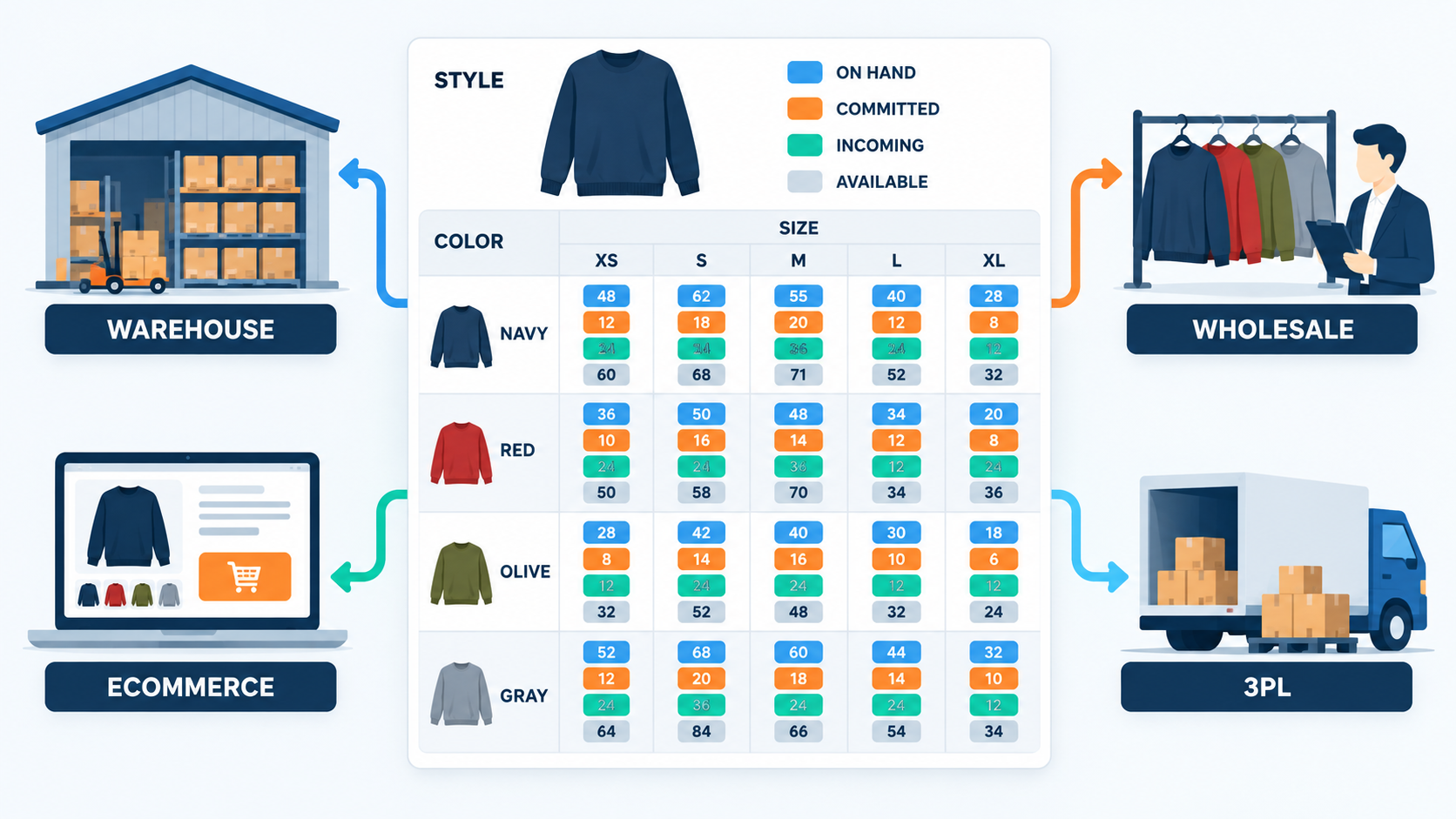
| Inventory state | What it tells the business |
|---|---|
| On hand | The physical quantity recorded at a warehouse or location |
| Committed | Inventory tied to open customer demand |
| Allocated | Units assigned according to fulfillment priorities and rules |
| Reserved | Stock deliberately held for a customer, channel, program, or status |
| Incoming | Expected supply from purchase orders or transfers |
| Work in process | Production that may become available when completed |
| Available to promise | The quantity the business can responsibly offer under its configured rules |
InStyle brings these states into the same operational system. Exact calculations and statuses can be configured around each company’s workflows, but the goal is consistent: prevent sales teams from promising the same units twice while still making future supply useful.
Available-to-promise for wholesale and future demand
Apparel is frequently sold before every unit reaches the warehouse. Wholesale customers book future collections, sales representatives write preseason orders, and ecommerce demand continues while replenishment is in transit.
InStyle can combine current stock, commitments, reservations, incoming purchase orders, transfers, and production expectations to support available-to-promise decisions. Users can evaluate not only what is physically present today, but also what is expected by a required date. This helps the business accept realistic future orders without confusing planned supply with immediately shippable stock.
Allocation that follows business priorities
When demand exceeds supply, allocation determines which orders receive inventory. The right answer may depend on order date, customer priority, cancel date, warehouse, channel, order status, or another business rule.
InStyle gives apparel companies a controlled allocation process rather than leaving teams to resolve shortages in spreadsheets. Planners can identify constrained variants, review demand, and apply the company’s fulfillment priorities. Because the system retains the style-color-size context, allocation decisions can be reviewed at both the detailed SKU level and the broader style or order level.
Multi-warehouse, location, and 3PL visibility
Inventory may be distributed across an internal warehouse, a showroom, a returns location, and one or more third-party logistics providers. A total quantity across all locations is useful for planning, but fulfillment also needs to know where the units are and whether that stock is eligible for a particular order.
InStyle tracks inventory by warehouse and location and can support interfaces with 3PL operations. Transfers and fulfillment activity can be reflected in the ERP so sales and operations teams work from a common record. The exact integration method depends on the logistics partner and implementation, but the objective is a single apparel inventory picture rather than separate 3PL and ERP balances.
One inventory picture across wholesale, ecommerce, EDI, and sales representatives
Apparel companies increasingly sell through several channels at once:
- Wholesale orders entered by customer service or sales representatives
- EDI orders from major retailers
- Ecommerce orders from Shopify and other storefronts
- Marketplace and digital wholesale activity, including Faire
- Reorders, samples, and special programs
InStyle can coordinate these order sources with ERP inventory, customer, product, price, and fulfillment data. Interfaces can exchange orders, products, inventory, shipment information, and other transactions according to the channel and implementation. Centralizing the operational record reduces the risk that one channel continues selling inventory already committed somewhere else.
For more detail, see how apparel inventory and wholesale orders can be synchronized across Shopify, Faire, EDI, and sales representatives.
Warehouse execution with apparel context
Accurate planning must carry through to the warehouse. InStyle supports receiving, transfers, order fulfillment, shipping, and inventory adjustments within the same apparel data model. Warehouse users work with the exact style, color, size, order, and location required by the transaction.
This connection matters when orders contain a large matrix of variants. Instead of treating a wholesale order as an anonymous list of SKUs, the system retains the structure that customer service and warehouse teams recognize. Shipping results can then update the order and inventory record used throughout the business.
Product development, sourcing, and inventory belong together
For brands and manufacturers, finished-goods inventory begins upstream. Materials are purchased, production is scheduled, work is assigned, and completed goods arrive against a plan. InStyle combines ERP with product development, sourcing, MRP, and production capabilities so future inventory can be understood in context.
Distributors that buy finished goods can use the inventory, purchasing, order management, allocation, and fulfillment capabilities without adopting manufacturing workflows they do not need. This allows InStyle to support both companies that design and produce apparel and companies that primarily distribute it.
A practical end-to-end inventory workflow
An apparel inventory process in InStyle can follow this sequence:
- Create or maintain a style with its colors, sizes, season, pricing, and product attributes.
- Plan supply through purchasing, production, or both.
- Receive wholesale, EDI, ecommerce, marketplace, and representative orders.
- Calculate availability using on-hand stock, commitments, reservations, and eligible incoming supply.
- Review constrained variants and allocate inventory according to business priorities.
- Release eligible orders to an internal warehouse or connected 3PL.
- Record fulfillment, shipment, transfers, returns, and adjustments.
- Use the resulting demand and inventory history for replenishment, sales analysis, and financial control.
The value is not any single screen. It is the continuity of the product and inventory record from planning through shipment.
Questions to ask when evaluating apparel inventory software
Before selecting a system, ask vendors to demonstrate real apparel scenarios:
- Can users enter and review orders in a style-color-size matrix?
- Can the system distinguish on hand, committed, allocated, reserved, incoming, and available-to-promise quantities?
- Can availability be evaluated by warehouse and required date?
- How does it prevent two channels from promising the same inventory?
- Can planners see shortages by style, color, size, order, and customer?
- How are EDI, Shopify, marketplaces, sales representatives, warehouses, and 3PLs connected?
- Can a brand track materials and production as well as finished goods?
- Can a distributor use the same platform without unnecessary manufacturing steps?
- Are allocation and availability rules configurable for the company’s actual policies?
- Does shipment activity return to the ERP as the operational system of record?
Why consider InStyle ERP for apparel inventory management?
InStyle is built for the dimensions and processes of apparel rather than adapting a generic item list after the fact. It connects style-color-size inventory with wholesale order management, purchasing, production, warehouse operations, ecommerce, EDI, CRM, and financial processes.
For companies comparing platforms, the important question is not simply whether software can store SKUs. It is whether the system can preserve apparel context while coordinating demand, supply, allocation, and fulfillment across the business. That is the problem InStyle ERP is designed to solve.
Related reading:
- How apparel software should manage style-color-size inventory, allocation, EDI, and 3PL fulfillment
- Best inventory and order management software for wholesale apparel distributors
- How the InStyle for Wholesale app helps apparel companies sell through Shopify
Frequently asked questions
Does apparel inventory software need a separate SKU for every color and size?
Each sellable variant generally needs a unique operational identifier, but users should not have to manage those identifiers as an unrelated flat list. InStyle keeps variants connected within the style-color-size structure so teams can work with both the complete style and the exact SKU.
What is available-to-promise inventory?
Available to promise is the quantity a company can responsibly offer after applying its rules to on-hand inventory, existing demand, reservations, eligible incoming supply, and timing. It is different from a simple physical stock count.
Can InStyle support multiple warehouses and a 3PL?
Yes. InStyle supports warehouse and location inventory and can be integrated with third-party logistics operations. Interface details depend on the 3PL, transaction requirements, and implementation design.
Is InStyle only for apparel manufacturers?
No. Brands and manufacturers can use product development, sourcing, materials, and production capabilities, while wholesale distributors can focus on purchasing finished goods, inventory, orders, allocation, warehouse operations, and fulfillment.
Can InStyle connect apparel inventory with Shopify?
InStyle supports Shopify-related services and interfaces, including wholesale workflows. The exact products, inventory, orders, customers, and fulfillment data exchanged should be defined during implementation.
Can InStyle manage raw materials as well as finished garments?
Yes. For companies that design or manufacture apparel, InStyle’s product development, sourcing, MRP, and production capabilities can connect material requirements and work in process with expected finished-goods supply.
See how InStyle fits your inventory workflow
Every apparel company applies different rules to seasons, channels, allocations, warehouses, production, and customer commitments. Contact InStyle Software to review your current inventory workflow and identify the product, order, warehouse, and integration processes that should be demonstrated.
Last reviewed: September 2026.


